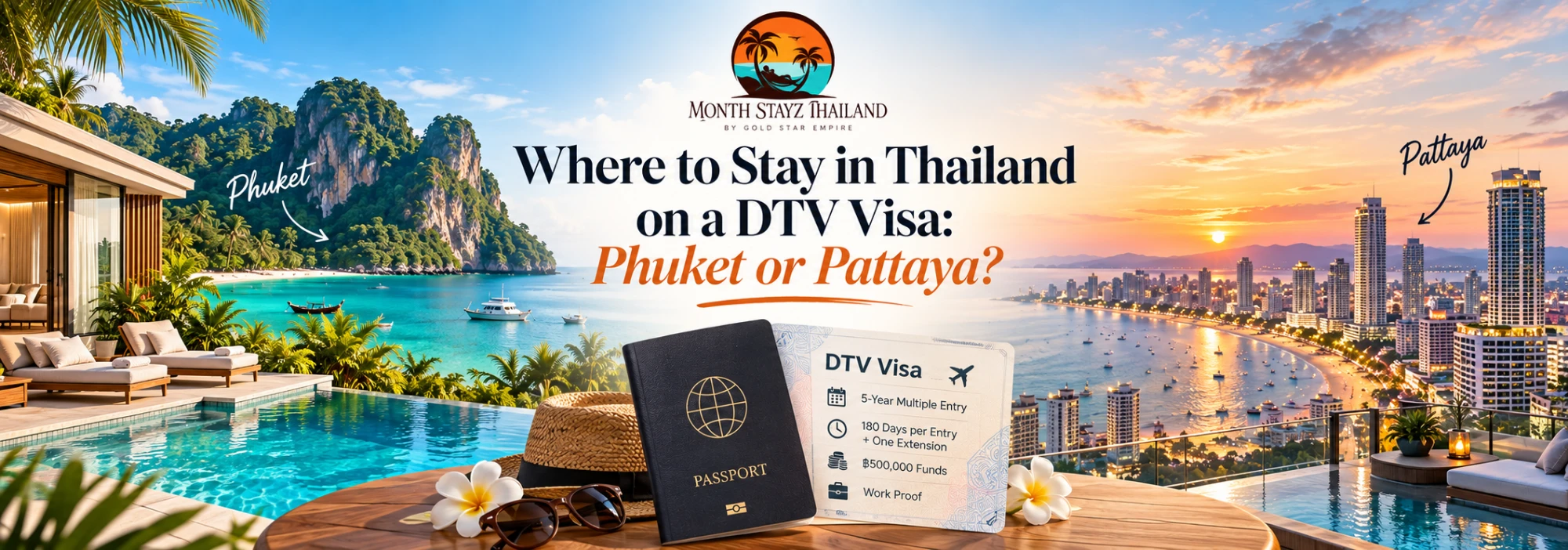
The Destination Thailand Visa (DTV) has made Thailand one of the easiest places in Asia for remote workers to stay long-term. A single visa lets you stay up to 180 days at a time, so the big question quickly becomes where to live. This guide covers the DTV basics, what changed in 2026, and how Phuket and Pattaya compare for a long stay.
Please note: visa rules change, and each Thai embassy can ask for extra documents. Always confirm the latest requirements on the official Thai e-Visa website and with the embassy or consulate you're applying through. MonthStayz provides accommodation and TM30 registration help. We don't process visa applications.
The DTV at a glance
- Who it's for: remote workers, digital nomads, freelancers and foreign talent working for employers or clients outside Thailand. It also covers people joining Thai "soft power" activities such as Muay Thai, Thai cooking courses or medical treatment, plus the spouse and children (under 20) of DTV holders.
- Validity: 5 years, multiple entries.
- Length of stay: up to 180 days per entry, and you can usually extend once at immigration for up to another 180 days.
- Money: bank statements for the last 3 months showing at least ฿500,000 (or the equivalent in your currency), or a sponsorship letter.
- Work proof: an employment contract or certificate, or a portfolio showing your remote-work or freelance status.
- How to apply: online at thaievisa.go.th, through the Thai embassy or consulate that covers your nationality or your country of residence.
What changed in 2026
Two changes catch applicants out:
- Criminal record clearance is now required. You'll need a certificate from your country of nationality, or the country where you're applying.
- Apply where you live. You need proof of permanent residence in the country where you submit your application. You can no longer choose any convenient embassy.
Embassies are also checking bank statements more closely, so keep the ฿500,000 in your account for the whole 3-month period rather than depositing it just before you apply.
Why a monthly rental makes more sense than a hotel
Up to 180 days is a long time to live out of a suitcase. A furnished monthly home gives you:
- A proper workspace: fast, reliable Wi-Fi and a desk, not a hotel bedside table.
- A real kitchen: you'll save a lot compared with eating out every meal.
- Regular cleaning: without paying hotel rates.
- Lower cost per night: monthly rates are far below nightly hotel prices.
- Easy admin: a landlord who handles your TM30 registration (more on this below).
Phuket: for space, nature and flexibility
Our Phuket villas suit DTV holders who want a private pool, a garden and a quieter island pace. Stays are flexible, from a few nights to several months, so you can start with a short stay and extend once you've settled in.
- Bang Tao: beach clubs and sunsets, popular with remote workers who want a social scene.
- Cherng Talay and Laguna: a good fit for families on the DTV dependant route, with international schools nearby.
- Nai Harn and Rawai: quiet beaches, yoga, wellness and a long-established expat community.
- Chalong: central, practical and good value for a long stay.
What's included: weekly villa cleaning, pool and garden cleaning, and free high-speed fibre Wi-Fi. Every villa is checked for fast internet and a proper workspace before it's listed. Electricity and water are charged by actual usage.
Pattaya: for city convenience on a monthly budget
Our Pattaya condos suit DTV holders who want cafés, co-working spaces, gyms and the beach within walking distance, and an easy trip to Bangkok. Stays are one month minimum, which suits DTV stays well.
- North Pattaya (Wongamat): calm, with a settled expat community.
- Central Pattaya: lively, with co-working cafés on every street.
- South Pattaya (Pratumnak and Jomtien): sky pools, sunset beaches and a quieter residential feel.
What's included: fully furnished condos with verified high-speed Wi-Fi and weekly housekeeping. Water is included and electricity is charged by meter. Monthly stays usually cost ฿20,000 to ฿70,000+, and the security deposit is ฿8,000 (one-bedroom) or ฿12,000 (two-bedroom).
Still deciding? Read our full Phuket vs Pattaya guide.
Admin to sort out after you arrive
- TM30 registration: Thai law requires your accommodation to be reported to immigration after you arrive. We'll handle your TM30 for you if you'd like, at both our Phuket and Pattaya homes.
- 90-day reporting: if you stay in Thailand for more than 90 days in a row, you'll need to report your address to immigration every 90 days. You can do this online or at your local immigration office.
- Extending your stay: if you want to stay beyond 180 days, apply for your extension at immigration before your permitted stay ends.
Your DTV move-in checklist
- Confirm the current requirements with your embassy and on thaievisa.go.th.
- Get your criminal record certificate and 3 months of bank statements ready.
- Choose your base: a Phuket villa or a Pattaya condo.
- Book your first month, and ask about better rates for longer stays.
- On arrival, let us handle your TM30, and note your 90-day reporting date.
Plan your DTV stay with us
Tell us your dates and whether you picture island life or city living. We'll reply with live availability and exact rates. Long-stay and returning guests get better rates, and you can extend if your home is still free.


.avif)



.avif)
